Wormwood (Artemisia absinthium) and black walnut (Juglans nigra) hulls are two of the most frequently paired botanicals in traditional parasite cleanse protocols. Both have long histories in Western herbalism for expelling intestinal worms and addressing digestive complaints, yet they differ markedly in their primary active constituents, proposed mechanisms of action, and safety considerations.
This article examines the traditional applications, phytochemical profiles, theoretical anti-parasitic mechanisms, and available evidence for each herb. It also highlights critical safety warnings — particularly wormwood’s neurotoxic thujone content — and the near absence of human randomized controlled trials supporting their use for parasitic infections.
Key Takeaways
- Wormwood and black walnut have distinct phytochemical profiles: wormwood’s sesquiterpene lactones and thujone-rich volatile oil versus black walnut’s juglone and tannins.
- Both herbs show in vitro anti-parasitic activity, but human RCT evidence for treating parasitic infections is virtually nonexistent.
- Wormwood’s thujone content poses seizure risk; it requires thujone-controlled extracts, short courses (2-4 weeks), and is contraindicated in pregnancy, seizure disorders, and with several drug classes.
- Black walnut is generally better tolerated but can cause GI irritation, contact dermatitis, and theoretical oxidative toxicity with prolonged high-dose use.
- Self-treating suspected parasites with herbal combinations delays evidence-based diagnosis and treatment; consult a healthcare provider for appropriate testing and prescription therapy.
Botanical Background and Traditional Uses
Wormwood (Artemisia absinthium) is a perennial herb native to Europe, North Africa, and parts of Asia, naturalized in North America. Its aerial parts have been used for centuries in European herbal medicine for dyspepsia, loss of appetite, fevers, and as a vermifuge — an agent that expels parasitic worms. It is also the defining flavoring in absinthe and a component of vermouth. Black walnut (Juglans nigra) is a North American tree whose green hulls (the outer covering of the nut) have been used in Native American and Eclectic medicine traditions for fungal infections, skin conditions, and as an antiparasitic, particularly for tapeworms and pinworms. The two herbs are often combined in commercial “parasite cleanse” formulas alongside clove (Syzygium aromaticum), based on the theory that they target different parasite life stages.
Key Phytochemicals and Proposed Anti-Parasitic Mechanisms
Wormwood’s bitter principles are primarily sesquiterpene lactones, notably absinthin and artabsin, which stimulate digestive secretions via bitter taste receptors. Its volatile oil contains thujone (both α- and β-isomers), a monoterpene ketone that in vitro demonstrates membrane-disrupting effects on parasites and antimicrobial activity. The proposed anti-parasitic mechanism centers on sesquiterpene lactones and volatile oil compounds interfering with parasite energy metabolism and membrane integrity. Importantly, wormwood is distinct from Artemisia annua (sweet wormwood), which contains artemisinin — a validated antimalarial drug with a different mechanism involving iron-dependent free radical generation.

Black walnut hulls are rich in naphthoquinones, chiefly juglone (5-hydroxy-1,4-naphthoquinone), along with tannins (ellagitannins and gallotannins), flavonoids, and fatty acids. Juglone is a redox-active compound that generates oxidative stress; in vitro studies show it inhibits enzymes essential for parasite survival and disrupts microtubule formation. The high tannin content contributes astringent effects that may create an inhospitable gut environment for parasites and reduce mucosal inflammation. These mechanisms are largely extrapolated from in vitro and animal data; human pharmacokinetic and pharmacodynamic data are lacking.
Evidence Landscape: In Vitro, Animal, and Human Data
For wormwood, anti-parasitic evidence consists mainly of in vitro studies against helminths and protozoa, plus a small number of animal studies. A few small, open-label human trials have explored wormwood for Crohn’s disease and SIBO (small intestinal bacterial overgrowth), not parasitic infections per se. No large, randomized, placebo-controlled trials confirm wormwood’s efficacy for treating confirmed human parasitic infections. For black walnut, the evidence base is even thinner: juglone’s antimicrobial and antihelminthic effects are documented in vitro and in veterinary contexts, but human clinical data are essentially absent. Neither herb has undergone the rigorous clinical development required for regulatory approval as an anti-parasitic drug.

Safety Profiles and Critical Contraindications
Wormwood carries significant safety concerns due to thujone, which is neurotoxic and can lower the seizure threshold. Thujone acts as a GABA-A receptor antagonist; high doses or prolonged use can trigger seizures, hallucinations, and cognitive disturbances. Regulatory bodies in the EU and US limit thujone in food and beverages; herbal extracts should be thujone-controlled (often <10 ppm or <3 mg/kg). Wormwood is contraindicated in pregnancy (uterine stimulant), breastfeeding, seizure disorders, and porphyria. It interacts with anticonvulsants, sedatives, antidepressants, and drugs metabolized by CYP450 enzymes (especially CYP2B6, CYP3A4). Allergic reactions can occur in individuals sensitive to Asteraceae family plants.
Black walnut hulls are generally considered safer for short-term use but are not without risks. Juglone is a potent skin irritant and can cause contact dermatitis; oral use may cause nausea, vomiting, and gastrointestinal irritation due to tannins. Theoretical concerns exist for liver and kidney toxicity with high doses or long-term use, based on juglone’s redox cycling and oxidative stress potential. Black walnut may inhibit platelet aggregation and interact with anticoagulants. It is contraindicated in pregnancy (insufficient safety data) and in individuals with nut allergies. Tannins can bind minerals and medications, reducing absorption if taken concurrently.

Practical Considerations: Forms, Dosing, and Quality
Wormwood is available as dried herb (tea/infusion), tincture (1:5 in 50-70% ethanol), essential oil (highly concentrated, not for internal use without expert guidance), and standardized extracts. Traditional dosing for digestive use: 1-2 g dried herb as infusion three times daily, or 2-4 mL tincture three times daily, limited to 2-4 weeks. Thujone-controlled extracts are essential; essential oil should never be used for parasite cleanses due to extreme thujone concentration. Black walnut is typically used as a tincture of fresh green hulls (1:2 in 50-60% ethanol), capsules of powdered hull, or liquid extract. Common traditional dosing: 20-30 drops tincture 2-3 times daily for 2-3 weeks, often pulsed (e.g., 2 weeks on, 1 week off). Quality markers include harvest timing (green hulls before blackening), extraction method, and third-party testing for contaminants (heavy metals, microbes, aflatoxins).
Why They Are Often Combined — and the Limits of That Logic
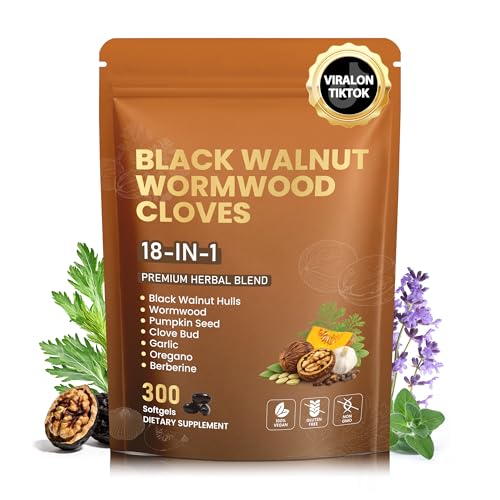
The classic “wormwood, black walnut, clove” trio originates from Hulda Clark’s parasite cleanse protocol (1990s), which posits that wormwood kills adult worms, black walnut hull kills larvae and eggs, and clove kills parasite eggs via eugenol. This life-stage targeting theory is plausible but unproven in humans. The combination also reflects traditional Eclectic and physiomedicalist formulas where bitter tonics (wormwood), astringents (black walnut), and aromatics (clove) were blended for broad-spectrum digestive antimicrobial action. Clinically, combination products may increase adverse effect risk (additive GI irritation, potential drug interactions) without proven synergistic benefit. Any parasite cleanse should follow confirmed diagnosis (stool O&P, PCR, serology) and medical supervision, not empirical self-treatment.
🛒 Where to Buy Wormwood (Artemisia absinthium)
- CleanseParasites Herbal Parasite Cleanse Powder Editor’s Pick
Contains wormwood alongside black walnut hull, cloves, and other traditional parasite-cleanse herbs. - Herb Pharm Intestinal Tract Defense with Wormwood
liquid, 1 fl oz — A Herb Pharm herbal formula containing wormwood extract, not a single-herb wormwood tincture - AlchePharma Organic Wormwood Capsules
capsules, 90 vegan capsules — Single-herb organic Artemisia absinthium, non-GMO and gluten-free - Nature’s Answer Black Walnut and Wormwood Alcohol-Free Extract
liquid, 2 fl oz, 2,000 mg per serving — Alcohol-free dropper extract; a black walnut and wormwood combination, not single-herb wormwood - Frontier Co-op Wormwood Herb, Cut and Sifted
cut and sifted dried herb, 16 oz bulk bag — Bulk dried herb for traditional tea preparation, kosher certified
As an Amazon Associate we earn from qualifying purchases. Quality varies widely — always choose a product with a published third-party test (COA) before buying.
A Note on the Evidence
This article is informational only and not medical advice. Evidence for anti-parasitic effects in humans is limited to traditional use and preclinical data. Suspected parasitic infections require medical diagnosis (stool testing, serology) and appropriate prescription treatment. Wormwood’s thujone poses seizure risk; both herbs have drug interactions and contraindications. Consult a qualified healthcare provider before use.
Frequently Asked Questions
Can wormwood or black walnut replace prescription anti-parasitic medications?
No. Neither herb has been proven in large human trials to eradicate parasitic infections. Prescription agents (e.g., albendazole, metronidazole, praziquantel) have established efficacy, dosing, and safety profiles for specific parasites. Herbal use should be complementary at most, and only under medical supervision.
Is wormwood essential oil safe for internal parasite cleansing?
No. Wormwood essential oil concentrates thujone, but the amount is chemotype-dependent rather than fixed: published GC/MS analyses range from about 1% trans-thujone[1] to 18.6% beta-thujone[2], so an unlabeled oil carries an unknown dose, and even the low end of that range puts one gram of oil well above the 3 mg per person per day EMA permits from wormwood herb preparations[3]. It should never be ingested for parasite cleanses. Only thujone-controlled herbal extracts (tinctures, standardized capsules) from reputable manufacturers are appropriate for short-term internal use.
How long can I safely take wormwood or black walnut?
Traditional practice limits wormwood to 2-4 weeks maximum due to thujone accumulation and seizure risk. Black walnut is typically used for 2-3 weeks, sometimes pulsed. Neither is intended for long-term daily use. Extended use increases toxicity risk without proven benefit.
Do these herbs kill beneficial gut bacteria?
Both have broad antimicrobial properties in vitro. Wormwood’s volatile oil and black walnut’s juglone and tannins can inhibit commensal bacteria. Clinical impact on human microbiome diversity is unstudied. Probiotic support during and after a course is theoretically reasonable but unproven.
What should I look for in a quality wormwood or black walnut product?
For wormwood: thujone-controlled extract (certificate of analysis showing <10 ppm or <3 mg/kg thujone), species verification (Artemisia absinthium, not A. annua), and third-party purity testing. For black walnut: fresh green hull tincture (not ripe hulls), harvest date, juglone standardization if claimed, and contaminant testing. Avoid products with proprietary blends that hide ingredient amounts.
Who should absolutely avoid these herbs?
Pregnant and breastfeeding women (both herbs), people with seizure disorders or on anticonvulsants (wormwood), individuals with Asteraceae allergy (wormwood) or tree nut allergy (black walnut), those with liver or kidney disease, and anyone taking medications with narrow therapeutic indices metabolized by CYP450 enzymes (wormwood) or anticoagulants (black walnut).
References
- Judžentienė A et al. Low-Thujone A. absinthium L. (Wormwood) Essential Oils and Extracts with Potential Antioxidative/Prooxidant Activity. Molecules (2026). PMID 42197106
- Rezaeinodehi A, Khangholi S. Chemical composition of the essential oil of Artemisia absinthium growing wild in Iran. Pakistan Journal of Biological Sciences (2008). PMID 18814663
- Committee on Herbal Medicinal Products (HMPC). Public statement on the use of herbal medicinal products containing thujone, EMA/HMPC/732886/2010. European Medicines Agency. EMA public statement (PDF)
- Weisbord SD, Soule JB, Kimmel PL. Poison on line — acute renal failure caused by oil of wormwood purchased through the Internet. The New England Journal of Medicine (1997). PMID 9297113
These statements have not been evaluated by the Food and Drug Administration. This information is not intended to diagnose, treat, cure, or prevent any disease. Content is for informational purposes only and is not medical advice; consult a qualified healthcare provider before starting any supplement. As an Amazon Associate we earn from qualifying purchases.