Artemisia absinthium, commonly known as common wormwood or absinthe wormwood, is a perennial herbaceous plant in the Asteraceae family[1]. It has a long history of use in traditional herbal preparations and as the defining botanical in absinthe and vermouth[1][2].
Accurate field identification is essential for foragers, herbalists, and botanists because several Artemisia species share similar silvery foliage and aromatic qualities. This guide covers the key morphological characteristics, ecological preferences, and the most frequently confused lookalikes to support reliable recognition.
Key Takeaways
- Artemisia absinthium is a silvery-white, tomentose perennial with deeply bipinnatisect leaves and nodding panicles of tiny, rayless yellowish heads.
- It thrives in sunny, well-drained, often disturbed habitats across temperate regions worldwide.
- The most common lookalike, Artemisia vulgaris (mugwort), has green upper leaf surfaces and white tomentum only beneath, plus more cylindrical heads in an erect panicle.
- Other similar Artemisia species differ in leaf division, tomentum distribution, inflorescence form, and scent profile.
- Year-round identification is possible using basal rosettes, stem and leaf texture, and aromatic odor.
Taxonomic Classification and Nomenclature
Artemisia absinthium L. belongs to the genus Artemisia, which comprises several hundred species in the tribe Anthemideae of the Asteraceae (daisy) family. The specific epithet ‘absinthium’ derives from the ancient Greek apsinthion, reflecting its long-standing association with bitter herbal preparations. No infraspecific taxa (subspecies or varieties) are widely recognized in modern floras, though regional morphological variation exists across its extensive range.
Morphological Description
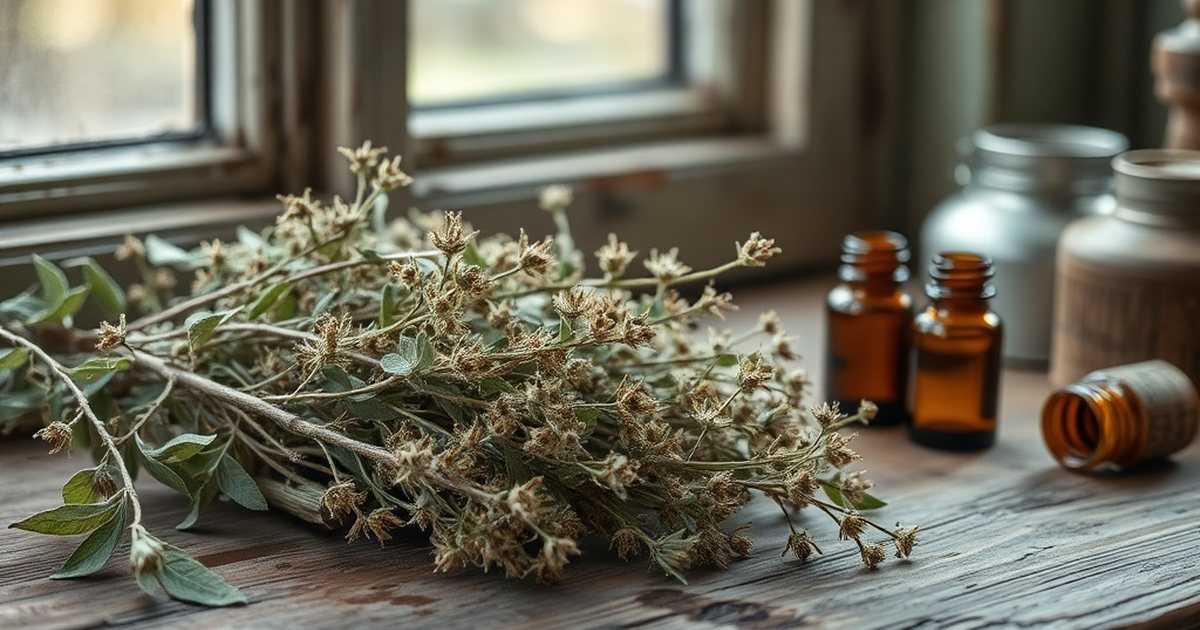
Wormwood is a woody-based perennial forming a clump of erect, grooved stems typically 60–120 cm tall, though plants in favorable sites may reach 150 cm. Stems and leaves are densely covered with fine, silvery-white trichomes (hairs) that give the plant a distinctive frosted, gray-green appearance. The leaves are alternate, deeply pinnatisect (twice or thrice divided) into narrow, linear-oblong segments; basal and lower stem leaves are petiolate and up to 15–25 cm long, becoming progressively smaller, sessile, and less divided toward the inflorescence.
The inflorescence is a leafy, nodding panicle of numerous small, globose flower heads (capitula) 2–3 mm in diameter. Each head contains only tubular disk florets — yellowish to pale green — lacking ray florets. The involucre (phyllaries) is imbricate in several series, also tomentose. Flowering occurs from mid-summer to early autumn (typically July–September in the Northern Hemisphere). The fruit is a minute, glabrous achene (cypsela) about 1 mm long, lacking a pappus.

Root System and Growth Habit
The plant develops a stout, branched taproot with lateral roots extending horizontally. This root architecture supports its perennial habit and allows persistence in dry, nutrient-poor soils. New shoots arise annually from the root crown. In cultivation or disturbed sites, wormwood can spread clonally via root fragments, forming dense stands.
Native Range and Habitat Preferences
Artemisia absinthium is native across temperate Europe, western and central Asia, and parts of North Africa. It has naturalized widely in North America, southern Australia, and other temperate regions following introduction for medicinal and ornamental use. The species favors open, sunny habitats on well-drained, often calcareous or sandy soils. Typical sites include roadsides, field margins, waste ground, dry pastures, rocky slopes, and abandoned gardens. It tolerates drought and low fertility but does not persist in waterlogged or heavily shaded conditions.
Key Identification Features Summary
When identifying wormwood in the field, prioritize the following combination: (1) perennial, woody-based clump with erect, grooved, tomentose stems; (2) leaves twice or thrice pinnatisect into narrow, linear segments, silvery-white on both surfaces; (3) nodding panicle of small, globose, rayless heads with yellowish tubular florets; (4) strong, characteristic aromatic odor when foliage is crushed; (5) flowering in mid- to late summer. The absence of ray florets and the deeply divided, densely tomentose leaves distinguish it from many congeners.
Common Lookalikes and How to Distinguish Them
Artemisia vulgaris (mugwort) is the most frequent confusion species. Mugwort leaves are also deeply lobed but are typically green and glabrous (hairless) or sparsely hairy on the upper surface, with a dense white tomentum only on the underside; its flower heads are more cylindrical and arranged in a more open, erect panicle. The aroma is less intensely bitter and more herbal-resinous.
Artemisia ludoviciana (white sagebrush, prairie sage) shares dense white tomentum on both leaf surfaces, but its leaves are usually once-pinnatifid (not deeply bipinnatisect) with broader, more lanceolate segments. Its inflorescence is a dense, spike-like panicle, and it is native to North America, often in prairies and dry open woods.

Artemisia abrotanum (southernwood) is a cultivated shrubby perennial with finer, more thread-like leaf divisions and a strong lemony-camphor scent; it rarely escapes cultivation and has a more woody, bushy habit.
Artemisia annua (sweet wormwood) is an annual with glabrous or sparsely hairy, bright green leaves that are deeply bipinnatisect but lack the dense silvery tomentum; its inflorescence is a loose, open panicle of very small heads, and it has a distinct sweet-herbaceous aroma.
Tanacetum vulgare (common tansy) superficially resembles wormwood in stature and aromatic foliage, but its leaves are once-pinnately divided with toothed, not linear, segments, and its flower heads are flat-topped corymbs of bright yellow, button-like capitula with conspicuous ray florets absent but disk florets showy.
Seasonal Identification Tips
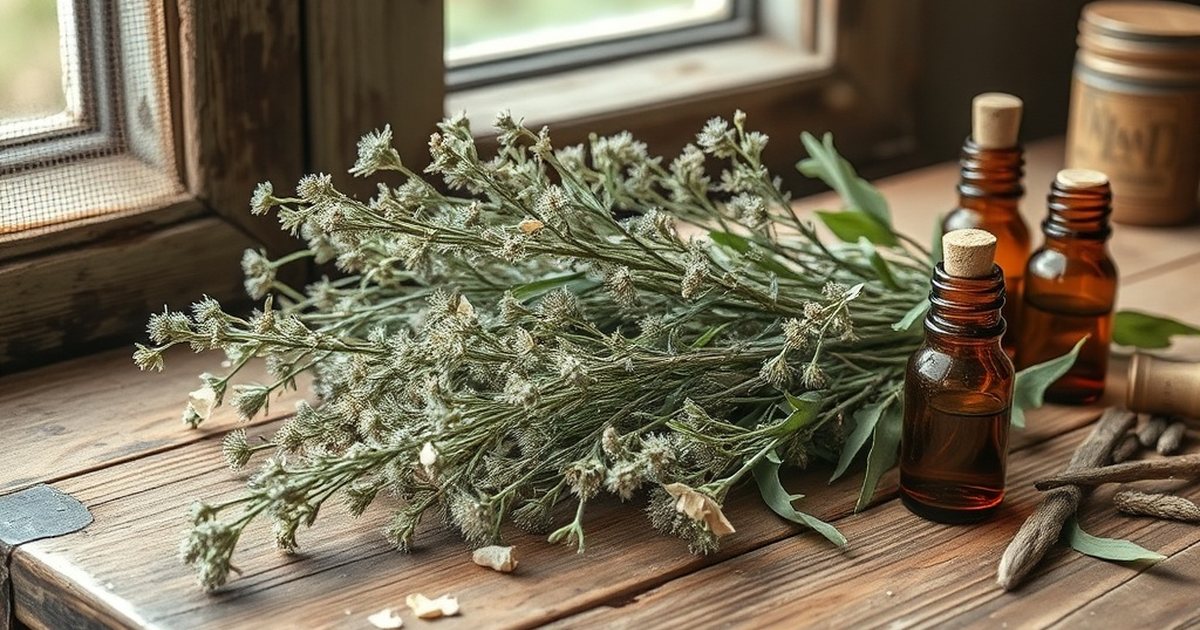
In early spring, wormwood appears as a rosette of basal leaves emerging from the root crown; the silvery tomentum is already evident on young foliage. By early summer, stems elongate and the characteristic leaf division becomes clear. Flowering shoots are most visible from July onward; even after flowering, the persistent dried panicles and woody stems allow winter identification. Crushing a leaf at any season releases the diagnostic bitter-aromatic volatile oils.
🛒 Where to Buy Wormwood (Artemisia absinthium)
- CleanseParasites Herbal Parasite Cleanse Powder Editor’s Pick
Contains wormwood alongside black walnut hull, cloves, and other traditional parasite-cleanse herbs. - Herb Pharm Intestinal Tract Defense with Wormwood
liquid, 1 fl oz — A Herb Pharm herbal formula containing wormwood extract, not a single-herb wormwood tincture - AlchePharma Organic Wormwood Capsules
capsules, 90 vegan capsules — Single-herb organic Artemisia absinthium, non-GMO and gluten-free - Nature’s Answer Black Walnut and Wormwood Alcohol-Free Extract
liquid, 2 fl oz, 2,000 mg per serving — Alcohol-free dropper extract; a black walnut and wormwood combination, not single-herb wormwood - Frontier Co-op Wormwood Herb, Cut and Sifted
cut and sifted dried herb, 16 oz bulk bag — Bulk dried herb for traditional tea preparation, kosher certified
As an Amazon Associate we earn from qualifying purchases. Quality varies widely — always choose a product with a published third-party test (COA) before buying.
A Note on the Evidence
This article provides botanical identification information only and does not constitute medical or foraging advice. Always confirm identification with multiple reliable sources before any use. Consult a qualified healthcare provider before using any herbal product, especially if pregnant, nursing, taking medications, or managing a health condition.
Frequently Asked Questions
How can I tell wormwood from mugwort in the field?
Wormwood has dense white hairs on both leaf surfaces and leaves divided into very narrow, linear segments; mugwort leaves are green and hairless above, white-tomentose only below, with broader lobes. Wormwood’s flower heads are globose in a nodding panicle; mugwort’s are cylindrical in an erect panicle.
Is Artemisia absinthium the same as sweet wormwood (Artemisia annua)?
No. Sweet wormwood is an annual with bright green, sparsely hairy leaves and a sweet aroma; common wormwood is a perennial with dense silvery tomentum and a bitter, pungent scent. They are distinct species with different chemistry and uses.

What habitats should I search to find wild wormwood?
Look on dry, sunny, well-drained sites such as roadsides, field edges, waste ground, rocky slopes, and abandoned gardens, especially on calcareous or sandy soils in temperate regions.
Can wormwood be identified when not in flower?
Yes. The combination of woody-based clump, grooved stems, deeply divided silvery-white leaves, and strong aromatic odor when crushed is diagnostic throughout the growing season. Basal rosettes in spring and persistent woody stems in winter also allow identification.
Are there any toxic lookalikes I should worry about?
The main confusion species (mugwort, white sagebrush, southernwood, sweet wormwood, tansy) are not considered dangerously toxic in typical contact or incidental ingestion, but each has its own safety profile. Positive identification before any use is essential.
Does wormwood grow in shade or wet soils?
It prefers full sun and well-drained soils. It does not persist in heavy shade or waterlogged conditions, which helps distinguish it from some moisture-loving Artemisia species.
References
- Szopa A et al. Artemisia absinthium L.-Importance in the History of Medicine, the Latest Advances in Phytochemistry and Therapeutical, Cosmetological and Culinary Uses. Plants (Basel, Switzerland) (2020). PMID 32825178
- Lachenmeier DW et al. Absinthe–a review. Critical reviews in food science and nutrition (2006). PMID 16891209
These statements have not been evaluated by the Food and Drug Administration. This information is not intended to diagnose, treat, cure, or prevent any disease. Content is for informational purposes only and is not medical advice; consult a qualified healthcare provider before starting any supplement. As an Amazon Associate we earn from qualifying purchases.